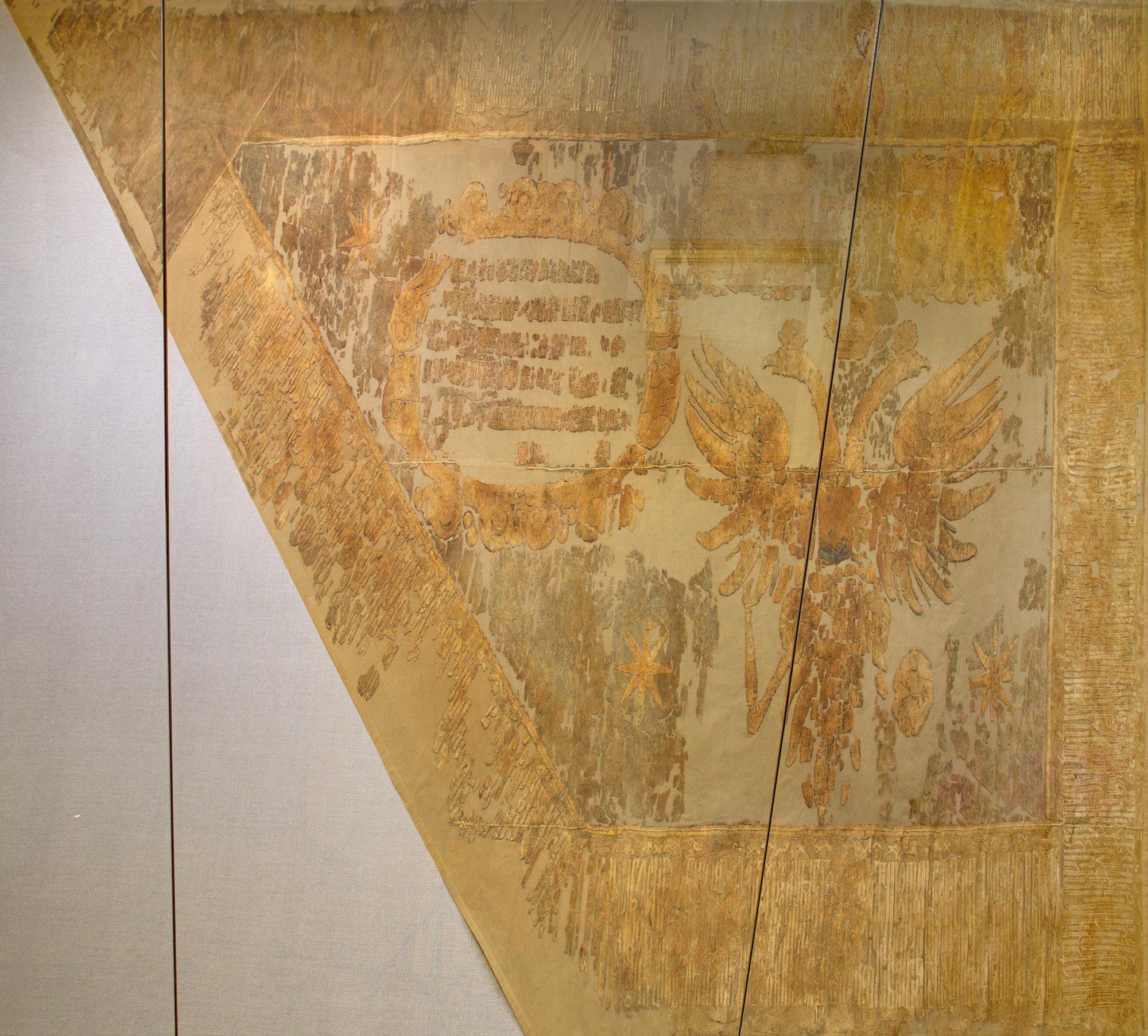
Flag of the Hetmanate
Author / manufacturer: Moscow Kremlin Armory
Technique and materials: silk, paints; sewing, painting
Dimensions (cm): 193 (height) x 412 (long edge) x 182.5 (shorter edge) x 294 (bevel)
Created in (year and place): 1686-1687, Moscow
Made of white fabric and decorated with golden trimming, the flag has a double composition. On the central front and back side, a two-headed eagle is portrayed holding a scepter and an orb, three crowns are depicted over his head. A shield featuring Saint George rests on the eagle's chest, a cross made up of 10 golden stars is placed slightly above. The trimming at the top of the flag is decorated with the portrayal of the Savior.
The flag has several cartouches of different sizes with various inscriptions made in old Cyrillic. The inscriptions on the trimming, almost 10 meters long altogether, are rendered in knitting. The back side of the flag is identical, except that the lettering on the trimming is substituted with a floral ornament. The inscriptions on the smaller cartouches bear a religious meaning. The largest cartouche in the corner of the flag features a legend with key information about its creation.
The larger inscription on the trimming of the flag contains full titles of the Russian regents Ivan V Alekseyevich, Peter the Great and their sister Sophia Alekseyevna of Russia. The lettering begins at the top left corner and then continues in two diverged streams to the bottom right corner near the flagpole.
Condition: restored.
History of acquisition by the museum: this is one of three Hetmanate flags in the world which have survived to this day. It previously belonged to the collection of the Museum of Sloboda Ukraine named after Gregory Skovoroda. Until 1932, the flag was stored in the Moscow Kremlin Armory. Later, by the decision of the Joint Commission on the Exchange of Cultural Assets between the Russian Socialist Republic and the Ukrainian Socialist Republic, the flag was transferred to the Gregory Skovoroda National Museum of Ukrainian History along with five other articles. In 1941 the relic was evacuated to the city of Ufa and was returned to Kharkiv on November 5, 1944.